

1: Introduction
2: Gaslighting in ‘Lucia di Lammermoor’
3: Donizetti’s own Mad Scene
4: Gaetano Donizetti
5: The Birth of the Mad Lucia
6: Enter Maria Callas as Lucia
7: The 1955 Berlin Lucia
8: Blood and Gore Throughout
1: Introduction
It is wonderful to hear an opera fully realised on stage with a orchestra and a great soprano, especially Lucia di Lammermoor. Even though Lucia was written two centuries ago, it still touches a few raw nerves today. It was composed in 1835 by Gaetano Donizetti at the height of the bel canto era. It’s the story of a disturbed young woman in Scotland based on a novel by Sir Walter Scott. It contains a famous ‘mad’ scene designed for a soprano to show off her virtuoso trills and skills. In those days the female soprano got paid much more than the male composer such was their pulling power.
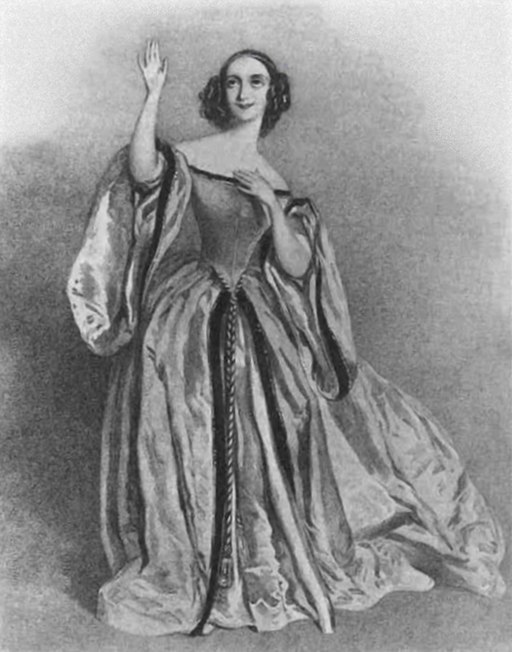
Lucia is a full-blown gothic tragedy with a ghostly apparition in a fountain, a murder and a famous ‘mad’ scene -oh and a love-pact suicide. To top it off, if you are lucky, the mad scene is performed with the ethereal sound of a glass harp instead of merely a flute.The programme notes at the Royal Opera House for the current production of Lucia has the warning: ‘blood and gore throughout’-16+ only.
Before we get to analyse the astrology of Donizetti and the iterations of Lucia which is what astrology does best- illuminate the themes- there’s the issue of the madness to deal with.
How can it be that someone like Lucia could go mad and then just die? Is that possible?
2: Gaslighting in ‘Lucia di Lammermoor’
Lucia is driven insane by her brother Enrico who piles on the lies and deceit until she cannot tell what’s true and what is not. This is called ‘gaslighting’ an idea taken from the famous 1938 play Gaslight by Patrick Hamilton. Lucia is forced to marry Arturo whom she does not love and becomes distraught enough about being coerced, but it’s believing her brother’s lies that triggers the real disintegration of her mind leading to her killing her husband on their wedding night. Enrico uses deceptive means to achieve his goal. He creates a forged letter and uses this to convince his sister that her lover Edgardo has betrayed her. It is the fake letter that ‘breaks’ her spirit.
 We may think this has nothing to do with us, but each time we are lied to, whether on a small scale or collectively by institutions, we can be nudged over the edge into a more confused state; each time it happens, we become more susceptible to further suggestions. Psychopaths such as Enrico are more common that one might think. According to Hare (1991) psychopaths are not the same as psychotics and not so obvious, so they tend to pass as normal. It is never easy to tell who they are as they may have very many positive traits. They are often very charming and persuasive with plausible reasons for everything they do. They are known to gravitate towards white collar fields like government and banking because of rich pickings and little accountability. They spread lies which may seem credible until the victim awakens and realises they have been duped. That feeling, if you have experienced it either personally or on a collective level, can be deeply corrosive and soul destroying. And it is also true that people can die of a broken heart. The heart is our electro-magnetic core linked to the Anahatta chakra, more central to our existence than given credit for and Broken Heart Syndrome is recognised medically as Takotsubo cardiomyopathy.
This brokenness comes under the province of Neptune and the sign of Scorpio as issues of psychopathology, sexual abuse, neurosis, hysteria, hypnosis, gaslighting, propaganda, delusions and believing fantasies are real are all classed as Neptunian issues. But also Mercury-Moon-Sun configurations can indicate the foundational trio of mind-body-spirt, especially where they are afflicted. I don’t want to suggest that it’s possible to spot exactly where mental illness lies in the natal chart – that is way too multi faceted. However, we can look at afflications of the Sun (the Self) and the Moon (feelings, emotions) Mercury (the Mind) and Jupiter along with any disturbing connections of Pluto (deep psychic roots) with Uranus (the nervous system). I would also look at asteroid Psyche as representing the soul. If Mercury is well placed and the Sun and Moon are in sextile or Trine, the conscious and unconscious are more in tune.
One feature of the psychopath as opposed to a psychotic is the disjunct between the words and promises they make of what they actually do. There’s a disjunct between the faleshoods and the truth, so many psychiatrists observe that a psychopath ‘knows the words but can’t hear the music’. They don’t feel deeply about the emotions underlying what words mean so can easily twist and distort them for their own nefarious purposes.
3: Donizetti’s own Mad Scene
Donizetti has Neptune in the sign of Scorpio so his artistry plummed the emotional depths. He was unafraid of these darker topics. He could definitely not just hear the music, he could make the notes transition from one extreme to the other to suggest instability of mind and bring madness to musical life. In this way Lucia’s ‘mad’ scene can help listeners empathise with what it is like to lose your mind. He composed several ‘mad’ scenes in Anna Bolena (1830), L’esule di Roma (1828), Maria Padilla (1841) and Linda di Chamounix (1842) elaborating in musical terms how the mind polarises so much as to become unhinged.
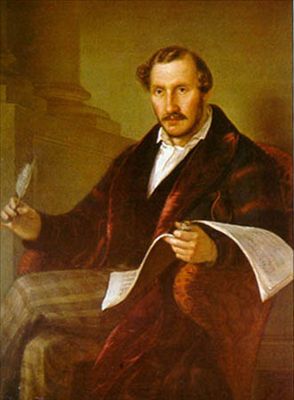
Some have even speculated that he could do this so well because of a prevision into his own later degeneration. This was said to be a case of neurosyphilis which eventually destroyed him thirteen years after he wrote Lucia. In 1845, his well-meaning friends and family lied to him saying they were taking him to Vienna where he had been employed as the emperor’s court musician, and that he had to stay in a hotel which was really an insane asylum at Ivry where they locked him up.
The hapless Donizetti believed he had been arrested. His letters clearly exclaim ‘Cursed be the one who lies!’
This gives the mad scene in Lucia extra poignancy and power as the derangement in music could contain insight into Donizetti’s own mental breakdown later on in life.
These mad scenes were all the rage in the early 19th century and are often cast in the light of Romantic excess. It was as if Lucia must have had some kind of a nervous breakdown because women were under pressure to conform to rigid societal rules. But this overlooks the very obvious role of the gaslighter- in this case Enrico- the one spinning the lies. This is serious abuse and happening everywhere, but to raise awareness, all the studies show that women are not always the victims, but can be the perpetrators too. But they are rarely depicted that way- at least in opera.
Romanticism extols the irrational, the ideal and can be cast as the very reverse of all that is practical, yet it is true to its own higher order of desires that strives to go beyond the material world. So Lucia speaks to us in the 21st century own times since mental imbalance is growing: Cluster B personality disorders, ADHD, malignant narcissism and psychopathy are massively on the increase especially among young people related to the overuse of their phones. It turns out that this method of playing with people’s minds is rife on social media and users become addicted to the dopamine hit of ‘the scroll hole’ before they know it. But if you are fed a diet of lies, it can trigger deep traumas and wounding, in which the imagined can seem more real and confusion operates like a slow growing tumor.
I compared the charts of Gaetano Donizetti with the opening night of Lucia in Naples 1835 with the chart of Maria Callas one of the most famous embodiments of Lucia going mad. The astrology not surprisingly, starts to show repeated themes and interesting alignments.
4: Gaetano Donizetti
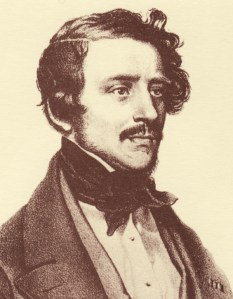
Donizetti was a Sagittarian born in Bergamo, Italy, November 29th in 1797. He was considered a very sincere, sociable person, both charming and supportive of fellow musicians and thus very well loved. He travelled a lot between Italy France and Austria. He was born in an era when Pluto was still in Aquarius, an air sign, as it is in 2024, but it would soon enter Pisces at the beginning of the 19th century when Europe saw Napoleon rise to power. There was revolution in the air- in the natal chart, literally with Pluto in an air sign, but that ‘air’ flowed like a current of electricity fracturing cohesion and reformulating the way people relate to each other as humans.
While Donizetti was growing up Neptune was transiting his own sign of Sagittarius from 1806 to 1820 no doubt bringing a flood of artistic inspiration as he was learning. The word ‘freedom’ is never far from the mind of a Sagittarian, and Donizetti’s work was sometimes associated with anti-clericalism and used as the rallying cry for the unification of Italy.
Sagittarius magnetises opportunities towards them and that certainly happened to Donizetti. He met a teacher, Simon Mayr, who assisted him to enter a music school in Bologna. He rose out of poverty via these opportunities but he had the natural talent which people recognised. He was prolific by any standard: writing 75 operas. He wrote quickly and was versatile enough to be proficient in differing styles, including string quartets and church music. He was able to write high and low, for tragic and comic opera buffa in works like L’elisir d’amore’ (1832) but also with a passion that connected to his audiences, especially in Naples. He allowed the influence of this Neopolitan street culture into his work where the singing could be florid, melodramtic, witty, yet hugely romantic and extremely popular.
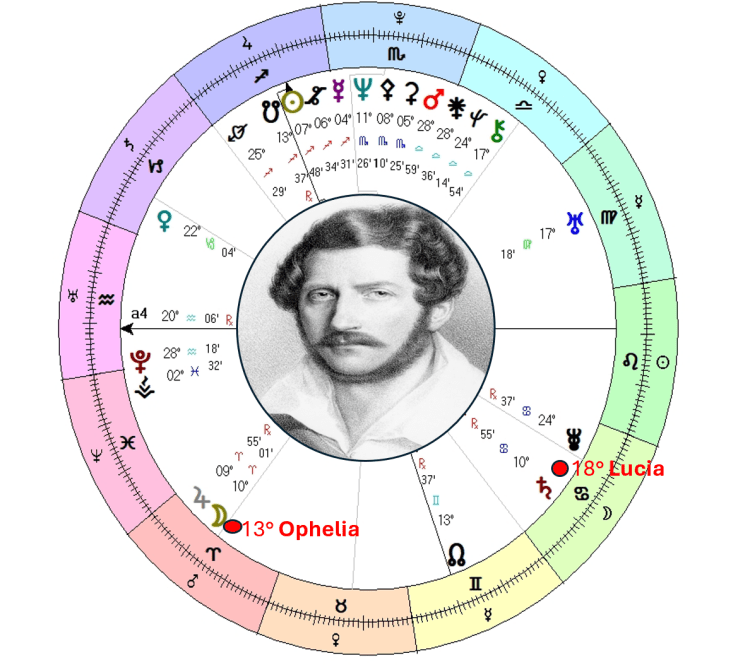
He had Jupiter conjunct the Moon in Aries. Jupiter with the Moon almost guaranteed his popularity- as Jupiter magnifies what it touches and the Moon can refer to people aka audiences. It trined his Sun and Mercury in Sagittarius- and a fire trine can trigger enormous inspiration. But this Moon/Jupiter also squared Saturn in Cancer. As to whether he was in touch with the zeitgeist, he must have picked up the mood, as he had these connections to outer planets. He had Neptune in Scorpio which likes to go deep into darker themes and into psychology. Neptune is trine to Saturn in Cancer which allowed for the emotional impact of his work to touch people’s hearts. The Mars at 28°of Libra was trine to Pluto adding drive and depth to his artistic work so his success was no fluke. He worked constantly. Donizetti was considered “the sole reigning genius of Italian opera” during the period between the earlier era when Bellini and Rossini reigned and the later 19th century when Guiseppe Verdi dominated. Donizetti was a massive influence on Verdi and probably obtained the idea of quartet in Rigoletto (1851) from the scene in Lucia where six characters interact dramatically.
As mentioned to pinpoint such a psycho-neurological illness would be too complex to get into. Donizetti contracted syphilis which it is said eventually lead to his physical and mental disintegration and it is not known when or where this began. There is no birth time for this chart, but some argue that whole sign houses can use house rulerships as pointers. In whole signs which do not differ greatly from Placidus, it is clearly seen that Uranus rules his Pluto in Aquarius, and Mars rules his Jupiter/Moon in Aries in injecting impulsiveness. Venus rules his Mars in Libra softening it and Uranus squares his asteroid Eros briging sudden loves into his orbit.
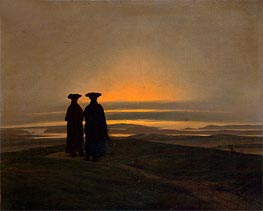
But we can also look at Neptune for clues. Liz Greene pointed to the recurring strong presence of Neptune in the charts of numerous artists and especially composers of the Romantic era even before Neptune was discovered in 1852. It was prominent in nearly all of their charts. Neptune is the artist’s planet, but it is also associated with strange cults and madness, even of the ecstatic and bizarre sort that flirts with suicide. It is when Neptune aspects other planets that it becomes ‘activated’ as the muse of ‘madness’ and going over the edge, especially for musicians. The line between genius and madness is notoriously thin. Neptune also stands for opera in the sense that at its core is the transmutation of death into some religious experience of the hereafter where two lovers jump into oblivion together as indeed they do in Tristan und Isolde (1865), the ultimate love and death ecstasy. But it happens in Lucia. Edgardo, her lover, swears to meet Lucia in heaven and she promises to wait for him there- when they are both dead.
To me that asteroid Eros is on the Galactic centre in this chart suggests a wild card energy too at the erotic level though Donizetti was apparently happily married. But he suffered when his wife and his children died. Donizetti’s South Node is on the Great Attractor point at 13° of Sagittarius, that galactic anomaly which devours other galaxies and gravitates the dark matter of the cosmos towards us. He may have allowed passions free reign or rested on his laurels though it is not easy to establish its effect.
5: The Birth of the Mad Lucia
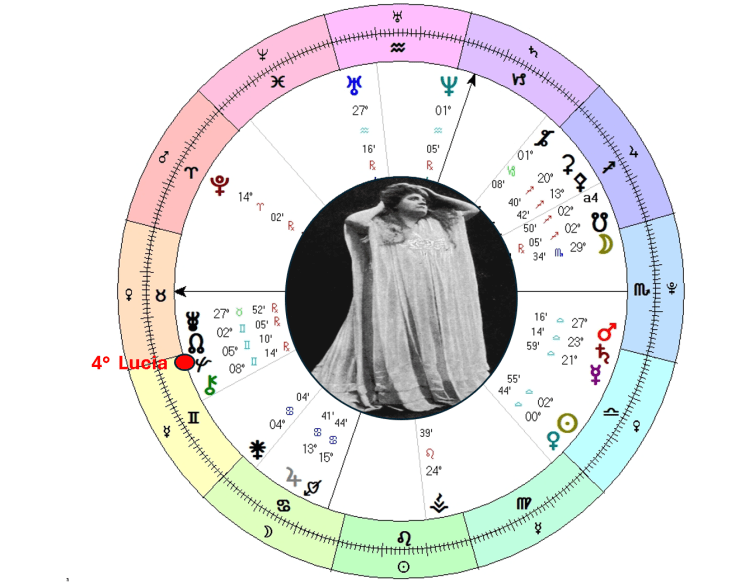
The premiere of Lucia di Lammermoor took place at the Teatro San Carlo in Naples September 26th, 1835. So even though in conception as an opera (not the novel) it would have been earlier in the year, the character of Lucia is that of a Sun conjunct Venus in Libra and Venus ruling the chart. but with a troublesome-looking Moon at 29° of Scorpio where the essence of that sign comes to fruition for good or ill. Neptune was just beginning its journey into the air sign of Aquarius – the kind of ‘air’ that is more like electricity.
The asteroid Lucia is at 18° of Cancer in Donizetti’s chart, not particuarly prominent, but remember he wrote dozens of leading characters in his operas. He does however have asteroid Ophelia conjunct Jupiter and the Moon in Aries. Ophelia was the original source of how a ‘mad’ scene should go from Shakespeare’s Hamlet. But in the Lucia premiere chart asteroid Lucia is at 4° of Gemini, midpoint betwee the North Node at 2° and asteroid Psyche at 5° Gemini . That is a way of saying Lucia’s life purpose was to find her ‘soul’ by wading into the sign of the mind but also of false and misleading information.
But the Mars with Saturn at 27° in the last decan of Libra is strongly disciplined and determined in artistic pursuits, but can struggle in relationships, but at the same time that can mean suppressed anger which can cause depression and other health problems. It can also suggest passive aggressive traits, the potential to bondage, and, if pushed, to murder? Since it is close to Mercury this could spoil any diplomatic words and strategies turning those same words into loose canons. This is all in the sixth house too where it is likely to cause ill health. It is a similar pattern we see in the chart of Maria Callas. Donizetti had Mars at this point too.
No chart could ever be said to clearly reveal the potential to murder a husband on her wedding night, whatever the justification. However, another reason this chart looks slightly unbalanced is the strong prominence of air signs and the lack of any planets in Earth signs. People often need to be grounded to stay stable and rooted in the body. The conjunction of The North Node with Chiron and asteroid Eros (plus asteroid Lucia) all in Gemini also hints at a deep wounding to the mind and soul where that is fused with love and sex, so this was challenge Lucia is destined to potentially resolve before it turned to tragedy. All these are opposed to the Moon at the anaretic degree in Scorpio. Pluto ruled by Mars in Aries is square to Jupiter in Cancer ruled by the Moon all of which makes Lucia extra volatile and emotional and perhaps liable to lash out.
6: Enter Maria Callas as Lucia
Maria Callas (2/12/1923) or (3/12/23) was also a Sagittarian and would have had a natural sympathy for fellow Sagittarian, Donizetti. She helped to revive interest in his work. While she was not the only Lucia to stand out, something about the sad plight of Lucia captured Callas’ imagination transmuted through her own troubles and difficulties with people around her.
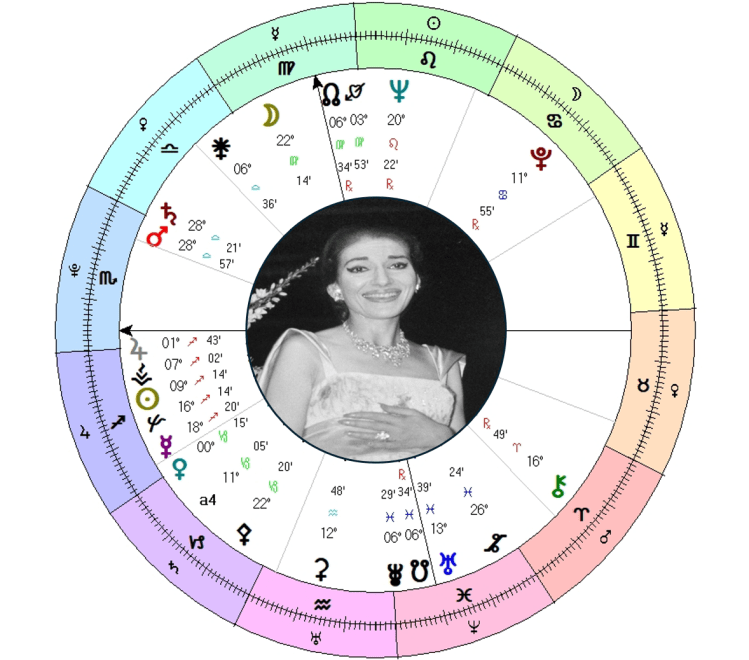
Callas was called a diva and a legend even in her lifteime, not just because it referred to her ability to channel the gods through her voice, but because she was capricous and demanding. She has asteroid Vesta conjunct the Sun which gives that utter devotion to her goals with almost religious fervour – the defender of the inner flame and art was placed on that highest pedestal.
She was a fighter, quite fierce, yet at the same time vulnerable, complicated and sensitive, and perhaps disconnected from her heart. In fact some suspect she died of a broken heart when in the 1960s Jackie Kennedy triumphed and snatched Onassis from her grasp. The visibly wounded Callas retreated from the world to her private room in Paris. But by then she has lost her voice and was no longer the supreme opera diva. These turbulent volatile qualities appeared early and made her the ideal choice to do a ‘mad’ scene.
There’s a strong Jupiter right at the first degree of Sagittarius, bringing that flair and largesse, and all those opportunities which she pounced upon from an early age. She captured the public imagination not just for her dark, velvety – and some said ‘ugly’- singing voice, but for the forcefulness and dynamism of her personality.Perhaps due to this early success, she even had a sense of entitlement too which polarised people and created enemies. As for inspiration she had Uranus in Pisces trine Pluto in Cancer, giving originality, depth and sensitivity to art and emotion.
She has Mars and Saturn conjunct in Libra which aligns with the Mars Saturn in the Lucia birth chart and with Mars in Donizetti’s chart. The Dec 3rd birthday puts Callas’ Mars at 29° of Libra and shifts the Moon from Virgo to Libra. So this is the troubled area I think where Mars can be dampened down and frustrated. This is not necessarily so good for balancing relationships either; perhaps it promotes ownership rather than partnership? Mars is drive and energy and Saturn is discipline and Callas had both in abundance. She was dedicated to achievement in her art in a way that was existential, ‘do or die,’ somewhat forced and very ‘war-like’ and strategic. She strove for excellence and never just to be merely good but to set the absolute record for that excellence. She did a recital that people called the ‘Impossible’ concert in 1952 where she attempted a wide range of styles- just as Donizetti did – from the most challenging arias in opera all in the same evening. She was a master technician however and pulled it off well. Most singers would have avoided it and not risked straining their voice. With Neptune in Leo this speaks of dramatic potential and she pulled Pasolini and Zeffirelli into her orbit – Pasolini even making a film with her as Medea (1969).
Callas was not a very good loser. You get the feeling that even with all the accolades and audiences who worshipped her, calling her ‘la divina’ she was never satisfied and always pushed for more. This suggests an underlying vulnerabilty. But it is definitely a workhorse energy and her ambition was ubridled and that was factored in to her first marriage with Giovanni Battista Meneghini (Leo) who was in effect her manager. He was considerably older than her; aged 51 to her 23 when they met. I think this is evident too in the Venus Saturn mutual reception: Callas has Venus in Capricorn ruled by Saturn, and Saturn in Libra ruled by Venus. The marriage suited them both very well for a decade and was genuine – until she met Onassis which devastated Meneghini who was abandoned.

But with the Mars-Saturn, it is hugely competitive and a sharpened will power. There is an intensity of controlled emotion here, detached and clinical, that could have come from early wounding from a sense of powerlessness. She could be soft and womanly, how she wanted to be perceived, but also sometimes asserted her power too forcefully. Mars pushes forward and cuts its way through obstacles, but Saturn holds back and defers gratification, and you can literally hear palpable tension in her singing voice. She took any slights very personally. You did not want to be in the room when she unleashed her anger as the venting had the explosiveness of a volcano.
Callas’ chart – whether you take the 3rd or the 2nd of December – aligns with Donizetti’s in ways that suggest twin souls: The Sun in the same sign just degrees apart, and the presence of Mars in Libra almost at the same degrees, so both their natal charts when lined up with the premiere of Lucia (26/9/1823) mark the 27-29 ° of Libra point. Plus, in both Lucia and Callas’ chart the actual conjunction of Mars- Saturn there in the synodic cycle of when Saturn and Mars come together in that last decan. This links September 1835 with December 1923 as while Saturn and Mars come together every two years, Saturn only meets with Mars in Libra roughly every 30 years e.g. 1982 and 2012.
Venus is highly significant in both Callas and Donizetti’s charts. They both had Venus in Capricorn. Sagittarius is in sextile relationship with Libra and they usually get on. With Callas and Lucia’s charts Venus is also prominent. This is not just because Venus rules the arts, and the theatre comes under her domain. Venus is placed at a crucial point in the calendar the 0° of the cardinal signs giving it that kickstart power for what is to come. So Callas’ Venus at 0° of cardinal Capricorn squares Lucia’s Venus exactly at 0° of cardinal Libra. Callas’ asteroid Lucia is at 0° of Aries so that position actually squares her natal Venus and squares Lucia’s Venus. That’s a whole lot of womanly tension to embark on the new season in the role of a woman driven mad by lies. It gives the work its lasting power.
7: The 1955 Berlin Lucia
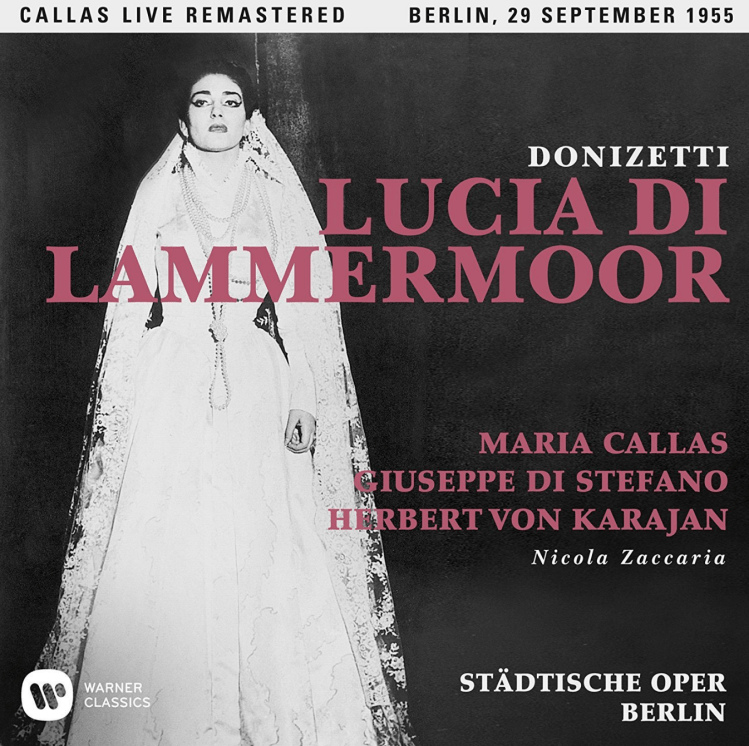
In 1955 a revised version of Lucia di Lammermoor was performed in Berlin sung by Maria Callas, with Guiseppe di Stefano (Leo) and conducted by Herbert von Karajan (Aries). This was in September 29th 1955 in the same season– the sun was just 3° away -as the original Lucia in Naples of 1835. Callas had just experienced an Eros return across her north node in Virgo. But Neptune was at 28° of Libra, and once again this emphasises the sheer musical artistry along with all the aesthetic judgements and hard work and energy this last five degree area of Libra where Mars and Saturn do their dance in the charts of Donizetti, Lucia and Callas.
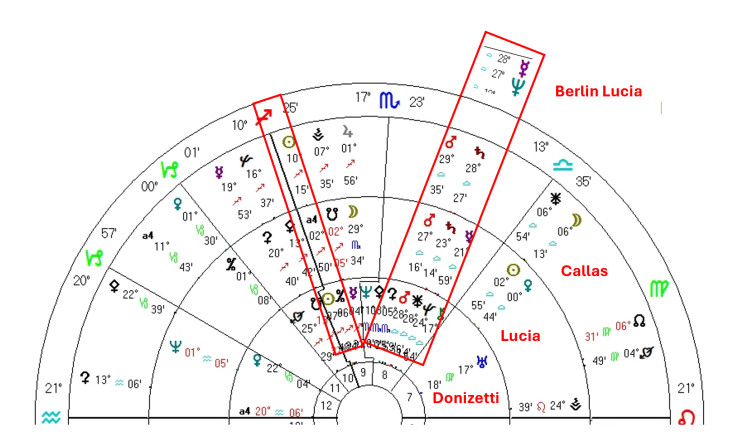 In Ptolemaic astrology, the last decan of Libra was ruled by Jupiter so with a strong link to Sagittarius, also ruled by Jupiter, but the modern rulership is Mercury. Callas’ Jupiter is at home at 1° of Sagittarius. Donizetti’s Jupiter is exalted in Cancer. But what is so fascinating is this area is continually marked out from the start of everything to do with Lucia di Lammermoor with Donizetti’s Mars there, Lucia’s Mars and Saturn, Callas’ Mars and Saturn and in this performance Neptune is there too elevating it to the realm of poetry, music and art. There is also an opposition of Chiron and Uranus which hovered on and off from the 1950s to the 1990s but in this case, it is exact at 0° of Aquarius and 0° of Leo in fixed signs.
Callas was able to render the depths of imeaning in the role, milking every phrase for its maximum worth. No one had heard it sung that way before. For audiences it was a revelation and it earned forgotten operas by Donizetti a fresh respect. Suddenly the trills had a darker, more nuanced meaning. Lucia’s mad scene began to make more sense not just musically but dramatically and psychologically. Lucia was no longer a piece of bel canto decoration, but an authentic tragedy. Callas was famous for her outbursts, and never one to hide her feelings, turned her back on Von Karajan because he allowed an encore of the sextet before she’d had chance to perform the mad scene. She was literally ‘mad’ at him. We can see this in the astrology but later she softened and what’s clear is her homage from one Sagittarian to another that restored Donizetti’sreputation.
8: Blood and Gore Throughout
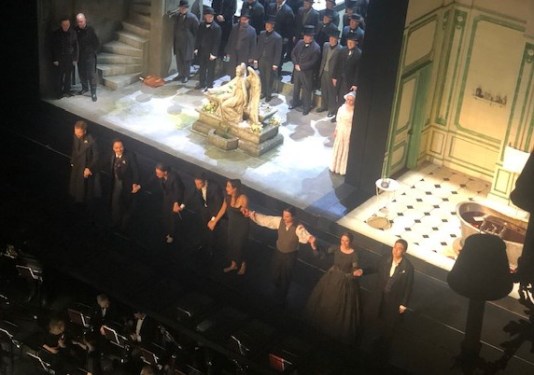
The current version at the Royal Opera House directed by Kate Mitchell (also Libra) who brought some ideas to the opera such as ghosts wandering about and climbing in and out of windows and lying on pool tables. She does not have any planets in the last decan of Libra but she is Libran. Her sun is at the same degree as the original Lucia, perhaps marking it as a special project for her. It lands on the Venus/Sun of Lucia adding Kate Mitchell’s Eros so this points to her empahsis is on the sexual elements of Lucia’s back story. She actually chose to depict details from the bedroom. The seduction of Arturo before he is murdered is graphically depicted. The nightdress is blood stained throughout the mad scene, making it also look like a hideous miscarriage. Hence the blood and gore warning.
This split-screen version first debuted in 2016 and has been revived in 2024. But it has polarised audiences with some disapproving reviews. Some may applaud the doll’s house presenation as innovative focussing more on the women in the story, but it takes away attention from the singers at key moments which is frustrating. The feeling is that people do not wish such liberties to be taken or the back stories to be fleshed out in such a distracting manner. The original libretto might be allowed to speak for itself. It’s a question of editing- some bits of the story were left out for good reason. The Von Karajan Lucia in 1955 worked because the stage directions had just one spotlight on Callas during the mad scene allowing her to ‘become’ the music.
Lucia will survive into future productions no doubt. She’s not going anywhere as this is a work of enduring quality and it is still eminently listenable. Jung comments that when the secret of great art is that it taps into the power of archetypes and this whether it is an image or primordial pattern, once this energy is channelled, it helps the artist “speak with a thousand voices” where somethiing much greater than the everyday personality shines through. Donizetti and Callas did that with Lucia.
As for learning the lesson from Lucia, it would be a good idea to take on board what Hare says about ‘soft’ psychopaths and become more aware of all the Enricos in your life and to stand firm against any machinations. Thankfully, it is Donizetti’s music which achives the dramatic impact and the mad scene is still as thrilling as it was in 1835, as it helps us to see what we can learn to avoid.
References
Gage, N. (2000) Greek Fire: The Story of Maria Callas and Aristotle Onassis, New York: Knopf.
Greene, L. (1996) Neptune and the Quest for Redemption, New York: Weiser Books.
Hare, R. D. (1993) Without Conscience: The Disturbing World of the Psychopaths Among Us, London: The Guilford Press.
Peschel E. and Peschel D.(1992) ‘Donizetti and the Music of Mental Derangement: Anna Bolena, Lucia di Lammermoor, and the Composer’s Neurobiological Illness,’ The Yale Journal of Biology and Medicine, 65 (1992), 189-200 https://www.ncbi.nlm.nih.gov/pmc/articles/PMC2589608/pdf/yjbm00051-0036.pdf
Kieron is a London-based and trained astrologer at Proteus Astrology on Facebook and his home page: #
Also on Instagram and Twitter Gab, Telegram, Patreon, MeWe. and Tumblr Bitchute, Rumble and Odysee
Natal Chart Readings via Skype or Zoom.
Book a chart reading: Eusastro@protonmail.com
Astrology can help you to understand:
- life patterns, purpose and life path
- relationships, business and romantic
- money, and what it means to you
- career issues
- personal and spiritual development
- vision, hopes and wishes
- choices and decisions
- planning for the future
- health and well being, aligning your energies
- stimulating creativity
- the best places to travel and live
 Proteus Astrology