

There are ghost stories that are forgettable and then there are ones that stick because they probe into more unsettling areas of the psyche. M.R. James is remembered for the distinct flavour of his spectral tales in which he basically invented the ‘antiquarian’ folk horror genre- with scenarios that have been widely admired and copied. Ghost stories are also best heard while sitting around the fire at Christmas while it is dark outside. While the Gothic tale was well established long before Montague Rhodes James, and Dickens made the oral tradtion of ghost stories at Christmas popular, it was M.R James who made this type of story totally his own.
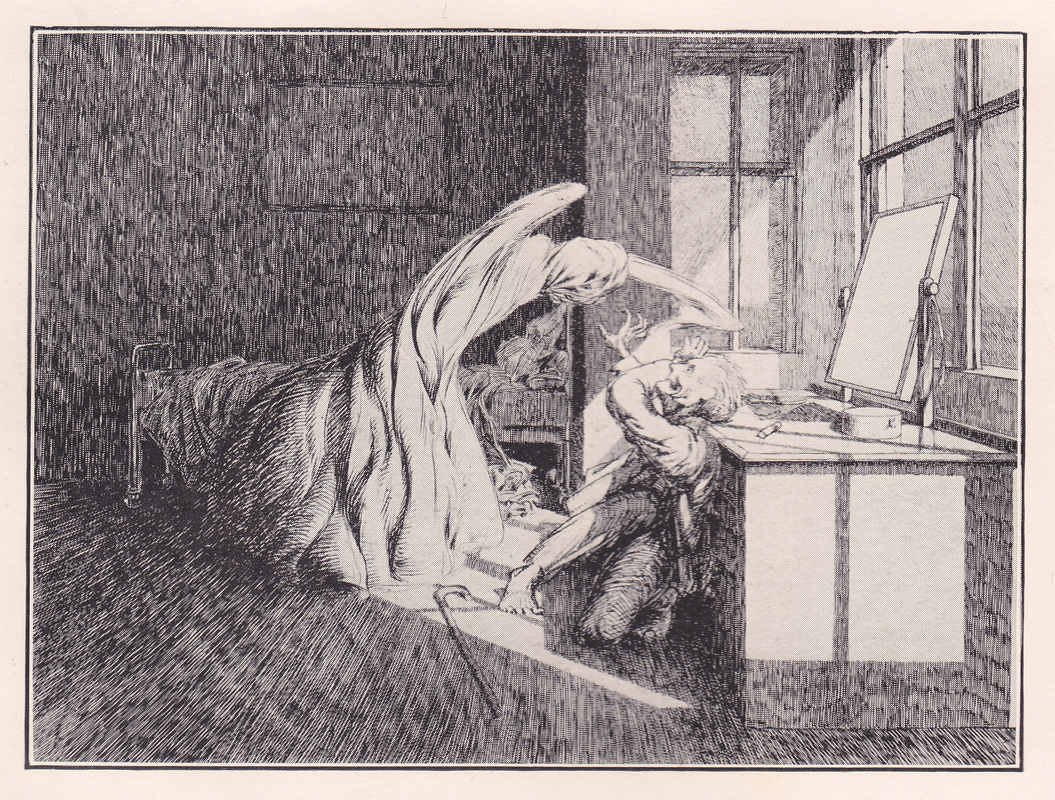
If you have ever seen the televised dramatisations – the Ghost Stories at Christmas series -you have probably felt spooked by the atmosphere which is carefully crafted to stick in your mind. It might be ‘Oh, Whistle and I’ll come, my lad’ (1904), ‘The Tractate Middoth’ (1911), ‘The Ash Tree’ (1904), ‘A View from the Hill’ (1925), or ‘A Warning to the Curious’ (1925) . They each create a believable world into which a chilling horror intrudes. The excitement is hard to explain as it sounds perverse but that we love the thrill of feeling afraid.
This was his modus operandi for how the telling of each story worked to best effect. There’s nothing obvious at first. The story often starts quite ordinarily, with people going about their business in broad daylight; and then someone discovers a book, a map, a pair of binoculars, a whistle, a drawing, or a sheaf of papers, an old crown, or some runes written on paper, or a manuscript with abstruse astrological symbols. Then these objects begin slowly to unleash the demons of the past. Suspense builds with subtle touches adept at amplifying the intellectual intrigue or mood – what James called his ‘nicely managed crescendo’- until before you know it, an un-nameable horror bursts forth violently. With this technique he became one of the most revered authors of the supernatural.
According to American author H.P. Lovecraft, no mean master of creeping horror himself, M.R. James had clear views how the stories should work “its spectral phenomena, moreover, should be malevolent rather than beneficent, since fear is the emotion primarily to be excited”. M.R. James was not prepared to make his creatures nice or fairy-like in any way. They are always malicious.
This slow-build technique towards visions of evil beings has been called ‘Jamesian’ but it is not the ‘Jamesian’ style to be confused with Henry James of ‘Portrait of a Lady’ and ‘The Golden Bowl’ elegance- although ‘Henry James’ The Turning of the Screw’ is a fine ‘ghost’ story. But M.R. James never left any amiguity that his characters had in fact been touched by the supernatural. He never explained it away. While there is little evidence in his statements during his life that he openly believed in a hidden reality, he did experience powerful nightmares and dreams that could have easily been the prompts to the demon forms and the human-like spiders and rats that haunt his protagonists. M.R. James’ stories feel very personally lived as they are evoked through sensory detail and we feel the goosebumps rise.
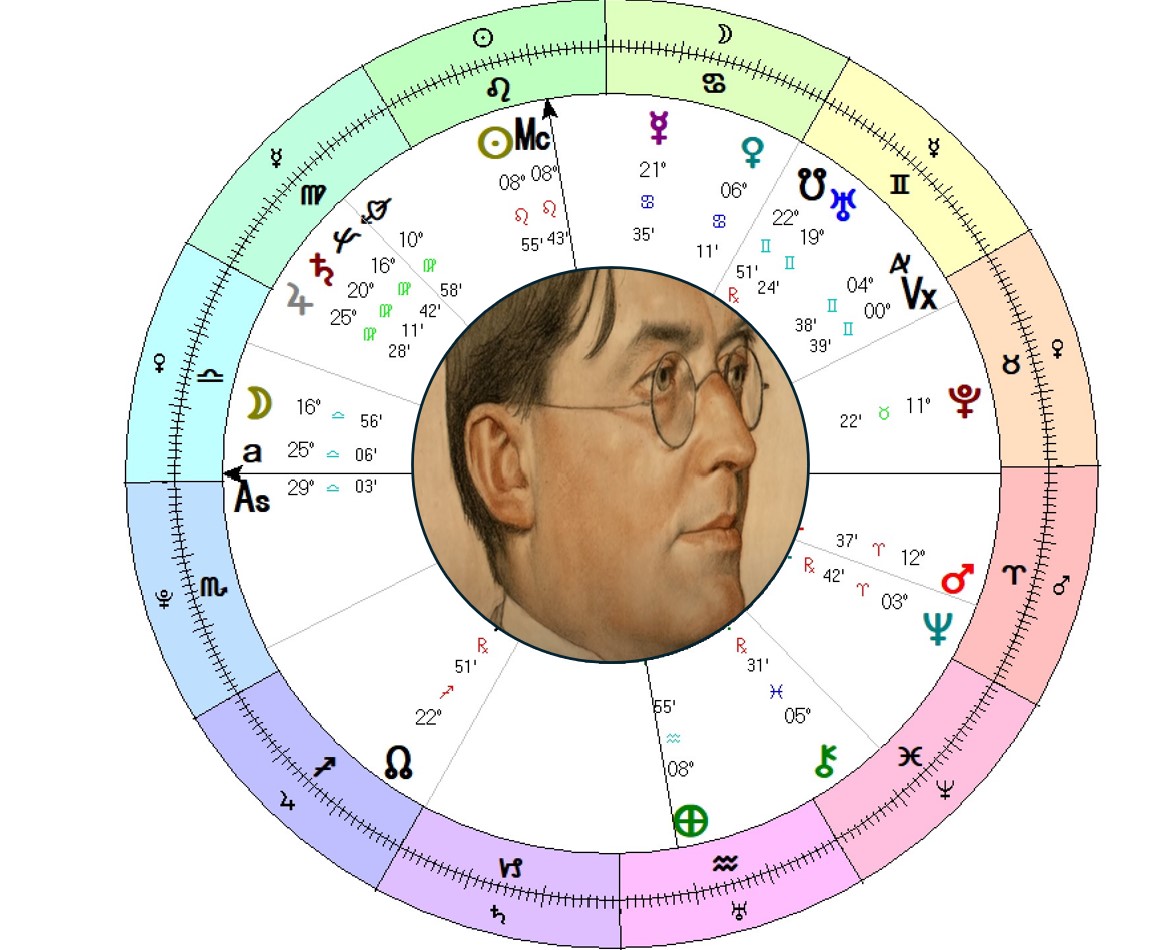
Montague Rhodes James was born in 1862 in the sign of Leo – the storyteller- with Mercury, the writer’s mojo, in the sublunary world of Cancer ruled by the Moon. This may have helped him call upon deep-seated and unsettling intuitions about all hidden menace that inhabits antique books, libraries, cloisters and assorted dismal and desolate locations, even on a windswept beach. Mercury here is opposite the asteroid Pandora who let all the evils of he world out of the box- so that could be relevant. Neptune in Aries is a pioneer of the imagination and with Mars in Aries he didn’t lack for boldness and wanting to be first. His Neptune is trine to the Sun bestowing plentiful inspiration from the spirit world. But Neptune is also square to Venus in Cancer adding the stronger, more cardinal edge to his fervid imaginings. Pluto is in Taurus also ruled by Venus and the rural English landscape settings of his stories are most striking. Pluto squares the Sun, so he certainly would have been aware of the dark side of life.
 He established a tradition of ghost story gatherings; telling the stories orally to his students at Eton college. They would sit around the fire with claret and anchovies on toast. That’s also very Leo- fondness for younger people and how to entertain them. The Leo archetype is about fathers and he lived in the shadow of his father, a successful academic, so there’s a sense he ‘lost’ his childhood. M.R. James was a skillful storyteller and loved his captive audience in order to ‘perform’ the tales which he would enliven by voices. He could mimic accents as needed.
James became a noted Medievalist and also held the role the Provost of King’s College Cambridge so he had a very well established reputation as a leading academic, just like his father. The painstaking detailed hard work of scholarship shows up us as Saturn in Virgo, and the enormous scope of his work gained him a reptuation as Jupiter there in Virgo too. M.R. James’ work cataloguing at the Fitzwilliam Museum in Cambridge has still not been surpassed. So he set the standard. The love of museums, curating collectibles and the the love of antiquities, spooked or otherwise, shows up as as Venus in Cancer.
He lead a cloistered life and avoided marriage as was expected of Victorian academics but Mark Gatiss’ documentary hints at suppressed sexual feelings gave James’ writings added power – the frisson of a sudden touch of hairy leg or arm and he disgust it produced could point to this. He did have several passionate friendships with young men, even after storytelling rolling about on the floor together with them, but nothing unusual was noticed at the time. He had a good sense of humour and was well loved by his friends.
Artist and illustrator James McBryde was one such friend. He was handsome and ten years younger than M.R. James and and they even went on holiday together- three years in a row. But in June 1904 McBryde died aged 30 after appendicitis surgery and M.R. James was griefstricken. But also la decade later the loss of thousands of young men to their death in the trenches of WWI increased his sense of isolation. His diary for 1914, the year WWI began, is completely blank. It was McBryde who encouraged M.R.James to publish and he provided the illustrations. M.R. James became welcome godfather to McBryde’s young daughter.
But this Jupiter-Saturn conjunction in Virgo squares that Uranus in Gemini. This particular synodic cycle of Jupiter-Saturn is affecting us at the end of 2024 in the form of an opposition of both these archetypes. This relationship of Jupiter-Saturn and Uranus is tense but could be highly constructive for a writer to have Mercury ruling these planets in this arrangement. But the energies they release could be dificult to reconcile. In July 2025 we’ll get a chance to feel exactly how inventive Uranus in Gemini might be once again. It was in Gemini upon its discovery in 1781 so feels at home there. Uranus is the higher octave of Mercury after all. It brings that surprise element to the characters- their oddness without being too obvious about it. Perhaps Uranus in Gemini describes the fuddy-duddy academic type he puts in his stories- these people who at a slight angle to the world, slight inept socially, but who are capable of gathering an encyclopaedic knowledge. They endure a shock to their nervous systems as the suddenness of evil bursts into their tidy studious world.
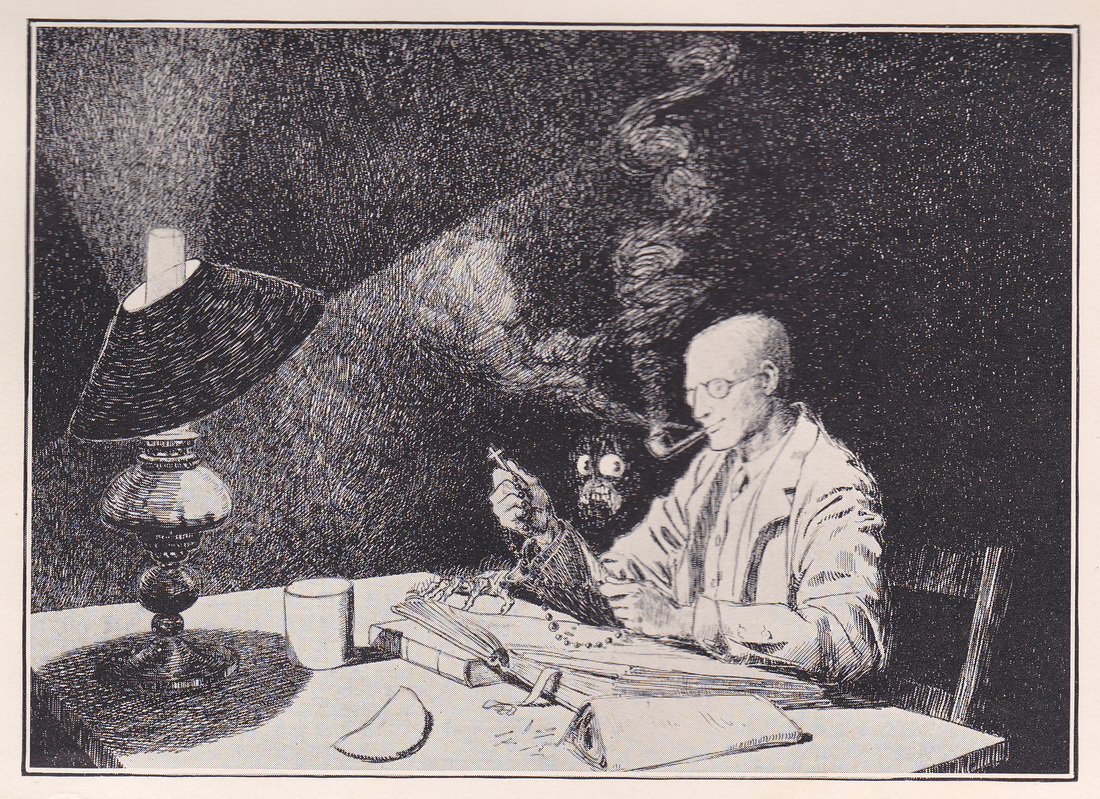
He was a very private person very much along the lines of a Scorpio. He was often called ‘reticent’. And apparently his handwriting was difficult to read, similar to Bram Stoker, who was in fact a Scorpio sun sign. So it could be likely that M.R. James, the Leo sun, was a Scorpio Ascendant- not Libra as shown in the midday chart based on an unknown birth time? This might make sense as the academics in his work, modelled on himself, have a ‘fixity’ of behaviour. They are traditionalists. This also places Leo in the 10th house suggesting a leading academic of his standing. He was ultra-cautious about what he said when asked for evidence of supernatural events. The hapless Mr. Parkin in ‘Whistle and I’ll Come’ declares this materialistic stance of the non-believer in superstitions, but this attitude fails to save him from the shadowy figure that pursues him and almost kills him. Definitely a warning to the curious.
While M.R. James poured himself into his work as provost, his ghost stories he considered just a sideline, it is the stories for which he is now more rememered. If any of the odd experiences related in these ghostly tales did in fact occur to him -‘drawn from life’ as it were- we’ll never know as he never revealed that at all. But some argue that he did have a powerful ‘sixth’ sense well attuned to darker psychic realities and he did live through the ‘mauve’ decade of the long-standing conjunction of Pluto and Neptune during the 1890s so he may have been influenced by that high weirdness to write these tales. He was in his 30s during that decade. He also talked of strange disturbing dreams and the Livermere Rectory in Suffolk where he grew up is said to haunted. He recorded having had a strange experience there.
His Neptune in Aries at 3° could point to his taking the lead in this area as we may discover when Neptune gets to 2° in 2025, but then Neptune retrogrades back into Pisces. It only finally reaches to 3° of Aries in April of 2026- that will be his Neptune return, the first time it has been there since M.R.James was born- that’s a full but long cycle extending beyond one life. I mention it only because to look for clues to the supernatual in a chart may lead on a wild chase- clear indicators of occult leanings are never self evident. He could easily have not been interested in the supernatual looking at his chart. However, perhaps the fact that asteroids Psyche and Eros are together in the sign of Virgo meant that all his psychic and erotic energies are ruled by Mercury giving him the ability to express them in writing is important. And possibly that his asteroid Scheherazade- the story-a-night narrator of the Arabian Nights told orally is at the very last anaretic 29° degree of Scorpio. It is conjunct asteroid Hekate across signs into Sagttarius giving it that darker twist. However, it is the strong Leo archetype that dominates the chart overall.
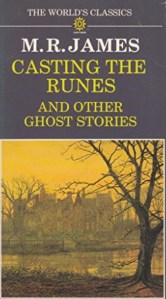 These disturbing experiences live on as stories only that still rank the finest works of the folk horror genre. They do not lose their spooky impact a hundred years on. One fine example is the story ‘Casting the Runes’ which was adapted into a film ‘The Night of the Demon’ (1957) and while it looks dated now in black and white, it still has the power to give people the shivers at the end. There s a careful build up to the last scene on the train involving the accepting of the paper Rune curse. The character of the occultist Mr. Julian Karswell is very likely modelled on Aleister Crowley about whom James would have heard a lot in the early 20th Century. Many modern horror scriptwriters and film directors and could really learn a lot from the slow and authentically ‘managed crescendo’ of M.R. James’ work.
Others like Bill Wallis go along with Gatiss and say that his stories were his own ‘unlived’ life, his own personal catharsis replete with sexual symbolism as these experiences tend to be described as ‘hot’ ‘pink’ ‘clammy’, ‘sticky’, ‘horny’ and ‘hairy’. This could help explain why he always resisted the pressure of his father- the heroic Leo struggle- for him to become a priest. James had no ‘patience’ for sex scenes in ghost stories and he was probably right. But it lurks off stage somewhere in the shadows.
Actor Christopher Lee, one of the finest ever to embody the role of Dracula and who was actually interviewed by M.R. James himself at Eton, said the James’ stories were so real they were like a “wall of terror than enveloped you” and that James was even a better writer than Bram Stoker as he managed to create a sense the evil is present lurking in the most everyday events where people are ‘undisturbed by forebodings’ until of course it is too late.
© Kieron Devlin, Proteus Astrology, December 29th, 2024, All Rights Reserved.
Astrology can help you to understand:
- life patterns, purpose and life path
- relationships, business and romantic
- money, and what it means to you
- career issues
- personal and spiritual development
- vision, hopes and wishes
- choices and decisions
- planning for the future
- health and well being, aligning your energies
- stimulating creativity
- the best places to travel and live
 Proteus Astrology