

1: Island of Gods and Demons
2: Balinese Astrology and Calendars
3: Balinese Birthdays
4: Temples and Megaliths in Bali
5: Woven into the Fabric of Life
1: Island of Gods and Demons
When I go on a long trip my Sagittarian sun kicks in and it often becomes a giant learning curve. For me these journeys can be like pilgrimages. It is the absorption of another culture that fleshes out the notion of the many in the one where I appreciate the sheer diversity and largeness of the world a lot more than is possible by staying at home. The world simply cannot be squashed into a postage stamp- and that is as it should be. Bali is no exception to this as it defies labels, and despite the influx of tourism, manages to preserve its ancient culture. It has long had an impact on visitors who are amazed at its beauty and integration of life into nature. In fact it symbolises a nexus of learning about sacred connections around the idea of ‘paradise’ – at least in the imagination- as this is an island of ancient Hindu and even pre-Hindu practices nestled among dozens of larger more Muslin neighbours and that makes it interesting on multiple levels for its resilience.
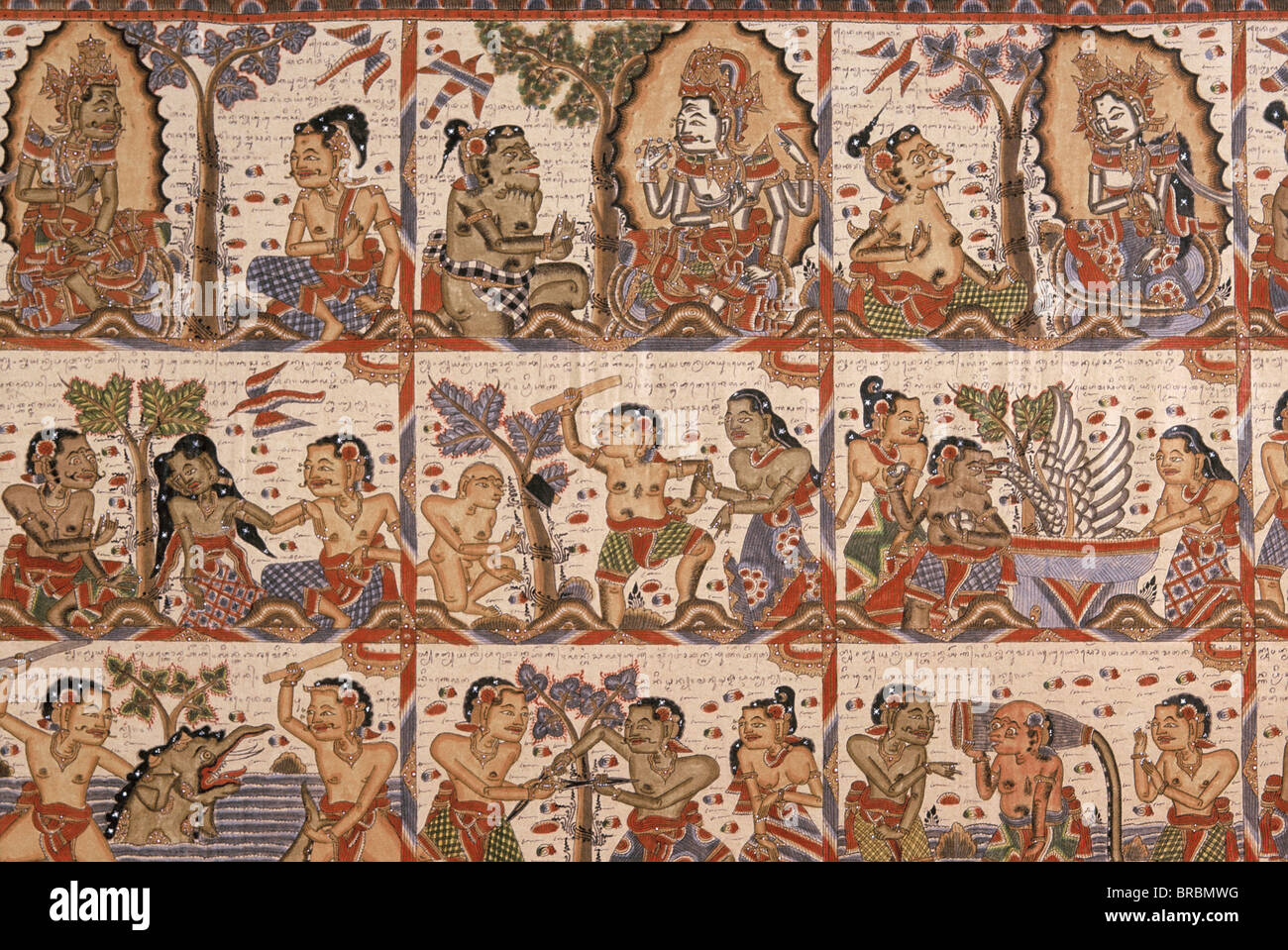
In Bali, for example, there is a completely different system of astrology not much known in the West. This system is based on the Pelelingtangan calendar which follows the rice cycle and divides up days by using the numbers 10, 7 and 35. A year to the Balinese is 210 days, not quite a full year of twelve months. That might seem overly complicated and to make it worse, not much is written about it so finding clear explanations is not easy. Asking Balinese people does not reveal much either. So with Uranus being Retrograde it sparked my curiosity and I was spun into a vortex of new thoughts, into considering something totally outside the box and that’s a healthy way of modifying and adapting your world view and not being fixated on the previous mental map.

Not only does Bali not follow the western system, it does not seem to follow any traditional Indian system of astrology very much, though it is influenced to some extent by the Indian and Vedic traditions through Hinduism. But there are hints of the Chinese system woven in to the Pelelintangan too with animal pictographs similar to the Chinese system and the use of the five elements.
To know your direction of North-South-East-West requires a more local space positioning. You should orientate yourself positioned in relation to a Sacred side versus a Profane side and that rotates around a central point. The ‘north pole’ of Bali is Mouth Agung which is the central mountain/volcano in Bali. What I find intriguing is how it exemplifies relativity as it depends on your position on the island to make sense- the mountain is the true north. If for example, you are north of Mount Agung, the sacred direction faces southwards, but if you live south of Mount Agung, the sacred direction is northwards. Orientation is relative to the mountain. This is a reminder of the schematic and relative nature of the Western concept of space on Earth and not to get hung up on that. Houses in Bali are generally built with this directionality in mind – the altars face Kaja – mountainward and the toilets and/or the animal pens face Kelod seaward.
In once sense this makes the entire island a sacred area and in Bali become conscious not just of the elemental spirits which can be intense at the abundance of rocks, forests and waterfalls but of which direction you are facing at any given point and what that means. Even the meaning of profane in Balinese-Hindu culture is not necessarily something to be loathed, avoided and rejected and demonised as in the Hindu world-view light and shade, good and evil, yin and yang must by their nature co-exist. It is better to just take it as it is a mixed good-bad balance. There may be a struggle but to banish one will not work as it will just bounce back in a kind of boomerang effect -what you resist persists. So this attempt to curse could be based a mistaken view of the universe and will inevitably bring bad karma your way. The pay off may not be how you imagined.

2: Balinese Astrology and Calendars
To even ask locals about their own system of astrology, makes them uncomfortable and they’ll most likely change the subject. The feeling is that it should not be talked about at all, or astrology is a mystery only for a few, those who have studied it and it’s not for the average person to comment. They might say that it’s best to ask the Ida Pedanda, the Brahminic priest as it is mingled in with black magic practices. The word for a healer is a Balian which is not to be confused with a national from Bali. A Balian is a shaman who may or may not know the astrology.
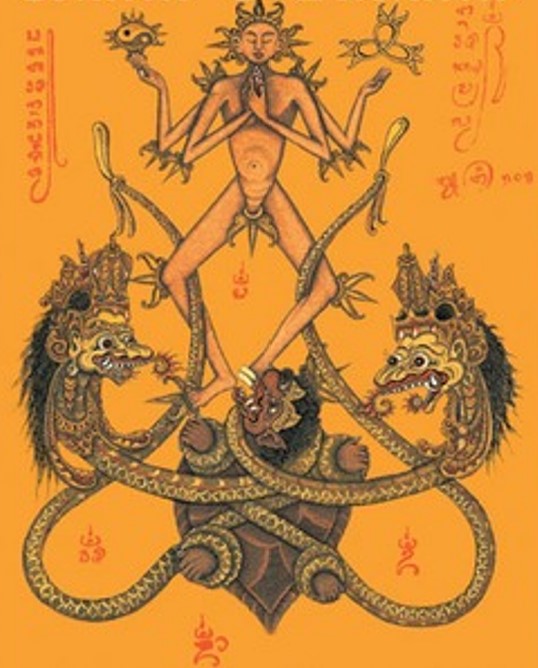
These are usually men though some women can be priests. They may not speak English and even if they do may choose not to divulge their knowledge to foreigners. There are many fake Balian-Shamans who just do it for the money – they pretend to heal but the person coming it is mingled with their beliefs so it may or may not work according to what the applicant thinks and believes about the experience. These words Sekala and Niskala are important. They translate loosely as Sekala, the tangible and Niskala the intangible, the seen and the unseen forces. This suggests that every Balinese person is familiar with the philosophy that nothing visible is without its invisible counterpart.
Niskala or unseen/occult forces operate in daily life. This is why there are offerings of flowers and incense at the portal of every house and business. There are also numerous guardian deities such as Sangutt and Melem and mythological characters that sit on either side of the door on guard for who and what passes through. These gargoyle-like creatures are positioned there for protection and prosperity and for not letting what does not belong through the doorway.
There is the Saka Lunar calendar where every month has 29-30 days begins on a new moon with the occasional extra month. That developed in South India in 78 AD and became established on the island and is the most similar to lunar calendars in the west.
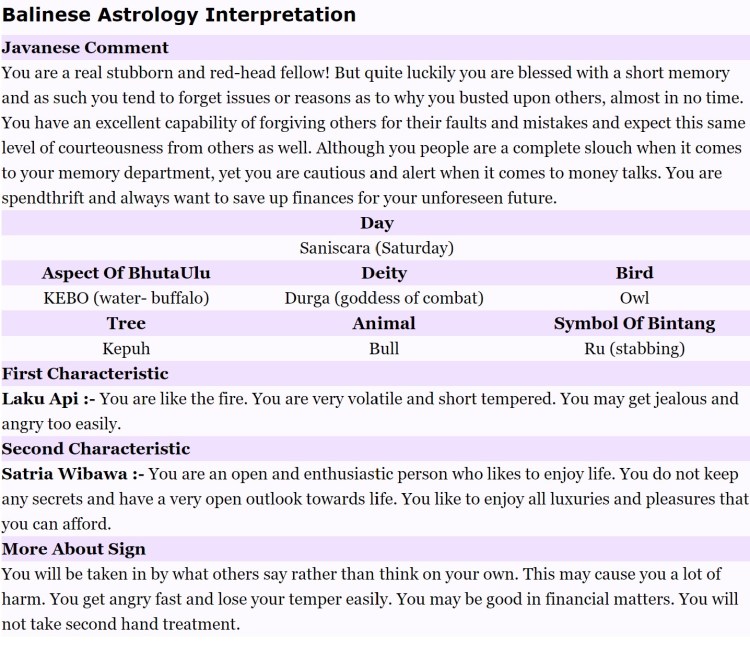
But then there is the Pawukon calendar which follows the rice cycles. The month has 35 days. One year of 6 x 35- day months lasts 210 days. This has 10 different weeks each of a different number of days that rotate in co-existing cycle. That means some weeks Tuesday does not always follow Monday but might have ‘extra’ days inserted. This calendar is used primarily for the timing of important ceremonies like the Galungan and Saraswati. The astrological signs are composed when this five-day week and the seven-day week are cross referenced into a grid where your day can be selected with a symbol into a Bintang also spelled Lintang which includes an animal symbol and a short description. Find out your Balinese astrology here.
Just to take one example: those born September 16th, 1989 are described like this with a Day, and Aspect, a Deity, a Bird, a Tree, an Animal, a Symbol and then two characteristics.
3: Balinese Birthdays
Balinese people have two birthdays: one by the international calendar that was only imposed in 1945 when Indonesia gained its independence after WWII and the other by the Balinese calendar. Indonesia is a Leo country- established on August 17th. While Leo represents all of the Indonesian islands, it is not so easy to find a birthdate for Bali in particular, yet the Leo aligns to the importance of their ‘story’ is seen everywhere and the Balinese are natural performers, dancers and musicians with Kecak and Legong dance ceremonies performed weekly. These are performed by communities and are not just for those who train to do so, all the villagers are involved in the dance, music, costumes and masks. They all contribute. But there’s also a Virgo feel to Bali -it has a flavour of India, only its own unique style in design, craft, sculpture, and in garden design, all much more tidied up and more organised. And the famous Legong dance performed in Bali requires two virgin girls to do the dance with intricate hand-eye-leg coordination which is described as ‘exquisite’. But it is also the home – some say the chakra centre- of yoga and multiple healing modalities.
This other birthday determined by the local Balinese calendar is known only if they know it. Many do not, or may only know one of their birthdays as people do not check the date or zodiac sign or do not care to know. This is not comparable to the personalisation you find from the Tropical system which uses both time and location coordinates as well as the day. But we might agree that everyone born on the same day might share at least some basic similar qualities.
One of the problems with reluctance to know or share a birthdate has to do with the prevalence of black magic practices on the island. Locals themselves say people are stirred by envy. Some people are willing to use a witch- a leyak– to curse those they don’t like. In many cases the recipient of this flow of malevolence is within the family, someone close who triggers those nasty feelings. Some go as far as blood sacrifices to curse people and cock fighting is popular in which the cocks fight to the death. Here’s where understanding karma can make a difference. Karma is just the consequences of any action- but it is for each person to work through the struggles with their inner demons and sift through the lower energies and transform them. To share a birth day with strangers therefore could give insight to the wrong people and be used against the person who shares. The priests use astrology also to tell which kind of spirit inhabits the body of a child, and it is not always the obvious personality.
I heard a story about the spirit of the ‘grandfather’ inhabiting the body of a young girl for a period of 10 years. This might go some way to explain why that girl may tend to act in temperamental and/or aggressive ways and then that behaviour changed dramatically after ten years as if it is someone else emerging. Balinese people know the Bhagavad Gita– it is the highlight of their holy scriptures- but they don’t always follow its encouragement from Krishna to Arjuna to become detached from the shadow play of events that pass in any one lifetime as their core essence does not change over many lifetimes. That’s a difficult one to remember.
Let’s say a person does not know their birth date, as no one recorded it or has a good memory of the circumstances. You can be creative: one Balinese man I encountered decided to DIY his own birthday. When the teachers asked him what his birthday was he didn’t know so he ran home to his father who also didn’t know. So he decided on a September date just out of sheer intuition and ran back to the teacher and told him the date he had created. That date stuck with him on all school records. It was an intuitive leap of faith. I can verify that he probably chose correctly as all those Virgo qualities apply to him in abundance.
For the sake of argument, some might say that it is not accurate, you can’t just invent your own birthday, but what if we could? Imagine that for a few moments. How different life could be. Less bound by fate I dare say. The chosen birthday could have symbolic significance like a personality by intention. One case in point is astrologer Walter Mercado whose birth date was self selected as Pisces and another that could have been the accurate one was as a Taurus, but he could have been both as both had relevance. Pisces was said to be the ‘official’ date. The Royal Family also put out different birthdates or even trigger births to a certain day by Ceasarian section, and perhaps this is to keep nosy people away from the real information. The invented dates take on a resonance of their own. This is a whole other layer of astrology we rarely consider possible but it relates to Electional Astrology where you select the most propitious date to embark upon an action. So again it utilises a magical world view where keeping secrets is important.
I also think that if we could choose our birthdays this way, we would learn to live more easily with those gnarly bumps of personality instead of fearing them and complaining about them. We would align and adjust more with events that push us beyond fate into a chosen destiny. it puts a whole new perspective on the meaning of ‘Electional ‘ Astrology, where choices are consciously decided and we are less victims of life’s event sequence. So there are many good reasons for doing what this man did- he took , fate into his own hands and charted his own universe.
4: Temples and Megaliths in Bali
Now I want to talk about megaliths and temple architecture as it struck me as unique in Bali. We think of megaliths as pre-historic stone circles that stand out from the landscape and mark the earth energies spot which aligns with the stars. But stones give off energy. They are not separate from the landscape but embedded at strategic points as and there is a fusion of knowledge in astrology, astronomy – at one time the same topic- and megaliths which were aligned with the movements of the sun and moon. Single stone menhirs do exist in Bali as many ancient peoples existed before the Majapahit dynasty in Java. They are often on the site of temples as the ground at those points is marked as holy. The position of any of these sites is therefore never random.

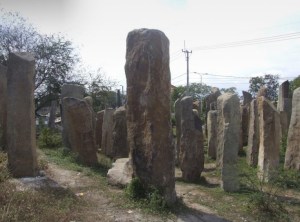
There are mysterious stones usually at key temple locations such as at Gunung Padang which appears to be a massive but collapsed giant pyramid, but this is in West Java. There are similar standing stones in Sanur in South Eastern Bali. What are they? Why were they built and by who? How long have they been there? These are the questions that become difficult to answer.
The highest temple in Bali is the Pura Tegeh Kahuripan near Kintamani. It is lodged on mount Penulisan which is a mile above sea level but the temple itself is 1745 metres above sea level.
It is described as ‘a megalithic relic from an old Bali age’ and has inscriptions carved into natural rock formations and several shiva linga stones which represent the phallus – these can be identified astrologically as the Sun, the pure life force. What is also special about this place is that the view at sunrise shows an alignment of the ‘trinity of peaks’. From the temple there is a view of Mount Agung, Mount Batur and Mount Abang as they all three can be seen together. This can surely be no accident.
Stranger still are the ancient people of Bali Aga who have unusual burial customs which were possibly a remnant of pre-Hindu practices. They live in the village of Trunyan east of Lake Batur and on Mount Agang and worship a god called Bhatara da Tonta connected to Batur Volcano. They do not bury their dead or do cremations as in most of the rest of Bali, but they wrap the corpses in a cloth and place them in a bamboo cage. The bodies are then left to decompose under a Banyan tree. That tree has an aroma that prevents the smell from rotting corpses becoming noticeable. This practice derives from the pre-Hindu sect the Agama Bayu who worshipped the stars and the wind.
Notice how temple architecture adapts to the landscape and marks sacred energy points on the psycho-topography of the island. Each temple has a specific design and purpose and its location is vital to understanding what is the purpose of the temple. Many are dedicated to certain deities like Dalem – a form of Shiva- and of Saraswati the goddess of the arts, learning, music and communication. She has similar qualities to Mercury and of Odin and also to the muses. One of the temples to Saraswati is in Ubud, is fronted by an enormous, tranquil Lotus pool.
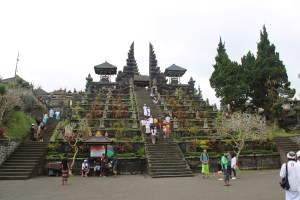
But the main three temple types that stand out as unique to Bali are the Kahyangan jagad, mountain temples; the Segara, sea rock temples; and the Tirta, holy spring temples. The Kahyangan jagad, or mountain temples are embedded into the slopes of the mountain like Besakih, the ‘mother’ temple embedded on Mount Agung which remember is a volcano and the highest peak in Bali, so it is literally on the doorstep of the gods.
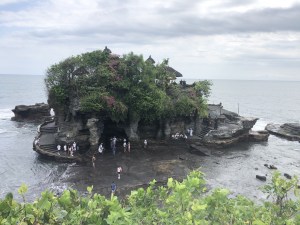
The Segara Sea Rock temples like the stunningly situated Tanah Lot and Uluwatu take natural rock formations and venerate them with temple architecture and worship. And then the Tirta temples are where the water source is holy, and have at the centre a ‘holy’ pool marking the water source. such Pura Tirta Empul near the village of Tampaksiring is a fine example and the whole place is centred around a holy spring which is venerated by doing ritual purification there. People stand under water pouring from sculpted openings and cleanse themselves several times in procession. Non-Hindus are allowed to take part as long as they show respect for the ritual by wearing a sarong. For men it is okay to have no shirt and that was true for Balinese women over a hundred years ago, when little was worn and children went naked. But the social norms have changed dramatically from that more innocent age and now they must dress modestly in the water.

Caves too become sacred spaces. One at Gah jah is known as the Elephant cave. The entrance is a gaping mouth of a demon. Also there are shrines built into the rock like those at Gunung Kawi near the water temple.
There is something about the whole island being marked as it has volcano at the centre which is the symbolic peak and home of the gods, so there’s no part of Bali that is not sacred in some way. It is called the island of the gods. The warmth and friendliness of the people go without saying and make it a very attractive place which is at the same time a living mystery with a complex history that is well preserved. Niskala the unseen is present and palpable everywhere to those who can feel it- that little psychic inside us all. All this elevates Bali into a place where manifestation seems to be more plastic, more available, faster to be realised. In Bali, the intertwining of the seen with the unseen is still appreciated and venerated and is not just a throwback from pagan times and from ore-Hindu animistic practices. This is refreshing and authentic to a world that has become cynically jaded as in the secular materialistic viewpoint which has long suppressed its archetypal and atavistic energies at its peril. It may be that it is living near a volcano that does it, you have to incorporate the spirit world into your life or die in an irruption of molten lava.
5: Woven into the Fabric of Life
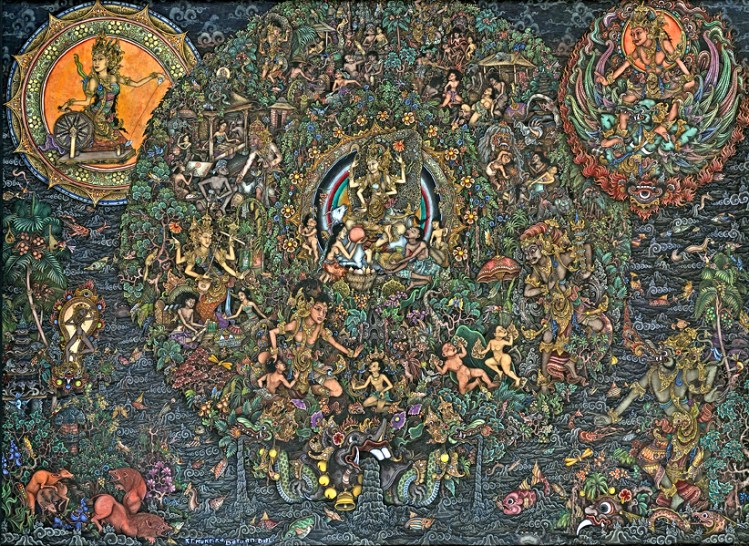
It would always be a moot point to say whether it is better to know astrology or not know it. But in Bali all their festivals and ceremonies are decided by their calendar, and the focus points are the temples, so this is a grand use of Electional style astrology i.e. ‘choosing’ the day. It is so bound up with the daily reality that people do not notice it is using the energy of ancient stones and using this underlying concept of the astrological significance of days and times: some are good and some are not. All astrologers take this for granted. They choose the most propitious date for events to take place. But this is woven into the fabric of life in Bali.
They say knowledge brings grief. Perhaps so, but as an astrologer my personal preference is that it is better to know it than not to know it. But if you didn’t know any astrology would it make such a difference? You can still live a reasonably good life, but you might also be blinded to the workings of the cycles and of fate, and repeated behaviours producing difficult tricky events would be a sign you are stuck. With astrology you can ride the waves much better. But the Balinese live their lives by it whether they know it or not as all their festival dates are decided through astrology.
Sometimes however astrology can become an obsession with technical language and forget its purpose is to embedded in life. It is at its best when it relates authentically to life events and be part of that fabric. At its worst, astrology it can become mindlessly abstract and theoretical. It comes alive when the synchronicities to a personal events in life are seen in parallel with the technology, and the as above matches the so below; as within, so without.
Ubud is the world chakra centre of yoga practice and yoga is a good metaphor for this weaving of a philosophy into everyday experience. Real yoga as it was intended to be understood is not just postures. The asanas are the starting point to train the body to allow the mind to be still- so perfection of poses is not the main goal. Yoga means ‘union’ and derives its philosophy from ancient traditions and the sutras of Patanjali. What can be difficult given we have a mind so easily distracted is this seeking of union within your personal experience, especially the everyday trials and tribulations which throw us off balance.
What yoga does hopefully is to help you strive to maintain the complex equilibrium of effort, tension and relaxation and ease within each event so that you happen to it, not that it happens to you and overpowers you. It is also mystical in the sense that the yogi seeks union with the divine in everyday experiences, being aware of karma-and dharma consequences and intentions both conscious and unconscious and your ultimate life purpose. I was reminded of all this while in Bali and being there can feed you on that level, awareness of the time and date and of the location all combine into an assemblage of experiences.
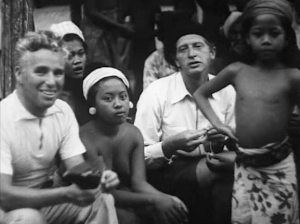
This may have been the effect that Bali had on Charlie Chaplin when he visited in 1932. He was in crisis and this island restored his faith in humanity and soothed his soul. His locational astrology has the Sun and MC right through Hollywood where he was the acknowledged master of silent film and where he was exhausted by all the politics of film making, but in Bali he was almost completely out of the limelight, very low key and it was far less stressful. He was fascinated by the Kejak dance and there he was able to learn Balinese dance by just copying the dancers. The nearest locational line has Jupiter and Chiron on the IC over in Timor, 722 miles East. Jupiter represents a good place to retire.
 It’s interesting to look at the two artists mentioned in Nigel Barley’s book ‘Island of Demons’. They lived and breathed Bali in the 1930s when it was less spoiled by modern life. Walter Spies (15/9/1895) was an artist, musician, curator and socialite and whose life became bound to the raising awareness of art and culture in Bali and a quick look at his astro-location places Pluto to the east, so that would make this area packing a wallop of power for him and never ever boring, but he also has the Sun crossing Venus a few islands away. So this whole region of Indonesia was a revelation to him as seen in his paintings which present this intense magical reality- the fusion of the seen and unseen- he experienced there. An added note is that he was arrested for being German during WWII and put on a ship to Ceylon with other prisoners. It sank off Sumatra when Jupiter squared the north node and Neptune was at 29 degrees of Virgo. He drowned that day in January 1942 with all the other cell mates, so he never got far from Bali even in death. This was close to the Uranus/MC angle on his chart.
And Rudolph Bonnet (30/3/1895), a Dutch artist who is the narrator in this book also lived and adored Bali. His astro-location shows he had his Sun line placed just West of Singapore and the conjunction of Venus and Saturn lines towards Flores island. So at least the Sun and Venus enclosed Bali and gave him some of the finest days of his life and perhaps he too felt bound to it with the Saturn there or it forced him to work harder at his art in competition with Spies.
I went to Bali on a hunch that it would satisfy a calling for a place where the sacred is still taken seriously. It certainly did that. In locational astrology Bali is roughly between my Neptune, Mars and Jupiter lines- this might suggest that I would find yoga, spirituality and expanded philosophy. I’ve certainly had plenty of that though the yoga was of the mind. The dark side would be deceptions, accidents on motorbikes and getting fat or lazy but if you strive for inner balance and don’t go to excess, you can attract the more elevated style of these three archetypes. It leaves me wanting to find out more and go back again.
© Kieron Devlin, September 19th, 2022, All Rights Reserved
Barley, N. (2009) Island of Demons, Singapore: Monsoon.
Eiseman Jnr. F.B. (1990) Bali: Sekala & Niskala: Essays on Religion, Ritual & Art, Volume 1, Jakarta: Periplus Editions.
Vickers, A. (2012) Balinese Art: Paintings and Drawings in Bali 1800-2010, Jakarta: Tuttle Publishing.
Deep thanks to all the people I met in Bali who helped me understand this little island.
Use the hyperlinks to find image credits.
Kieron is a London-based and trained astrologer at Proteus Astrology on Facebook and my home page: Find me on
Instagram and Twitter Gab, Telegram, Patreon, MeWe. and Gettr
Natal Chart Readings via Skype or Zoom.
Book a reading: Eusastro@protonmail.com
Astrology can help you to understand:
- life patterns, purpose and life path
- relationships, business and romantic
- money, and what it means to you
- career issues
- personal and spiritual development
- vision, hopes and wishes
- choices and decisions
- planning for the future
- health and well being, aligning your energies
- stimulating creativity
- the best places to travel and live
 Proteus Astrology